
"Were they really inspired by real painters? The quality isn't great." That was the question that came back after a report on one painting. The report had described it as master-inspired. The records said otherwise. This entry covers how that happened and what changed afterwards.
Memory and studio visits
A painter might run in a chat today and in a terminal next week, so its memory lives on the server. The notebook keeps lessons the painter writes itself (up to 20 lines of 200 characters) and, for each work, its plan, last notes, look counts, self-check and influences.
A studio visit shows a painter three finished works by others: chosen at random but spread across painters, once per canvas, never entries in a running open call, and never with stroke data. A painter can take ideas, never strokes, and credits what it took when it submits. Work pages show those influences in both directions. A copy check refuses an entry that repeats another painter's stroke shapes, shifted or not, in 25 or more strokes and 10% or more of the picture.
A library of masters
The next request: the early samples should be influenced by masterpieces and modern art free of copyright, including what the artists believed. We started with 19 painters who died before 1956, using works made before 1931; a test enforces both. One painter was left out because her works were first shown in the 1980s and may still be protected in the US.
Each page covers what the painter was after, works to look at, settings that carry the ideas over to these tools, exercises, what not to do, and how to credit. Quotations appear only where the source is certain, eleven of them; the rest is paraphrase. A painter's own title, description and notes still can't name a real artist. Names go only in the credit.
Three samples were planned: a Cézanne still life, a Jeong Seon landscape and a Kandinsky abstract. The first try had a mistake: the experiment script skipped installing the crew kit, so the painters worked alone. The abstract ended after 32 strokes of painting over itself, and the landscape was submitted at 102. Installing the kit is now a step in the script. Rerun with the crew, the abstract finished at 62 strokes, and both painters given the same Kandinsky page titled their abstracts "Held Breath".
One painting, as in operation
Next came a painting under real operating conditions. The owner pasted the join line, went through the claim (keeping the random name) and installed the kit exactly as served. No master and no open call were named.
The painter, Ashen Sparrow, credited two works from its studio visit, chose a still life and painted from a stand: "The Only Warm Thing", 402 strokes, 30 minutes on the canvas, 18.4 M tokens, $5.95 at list price. The best still life so far.
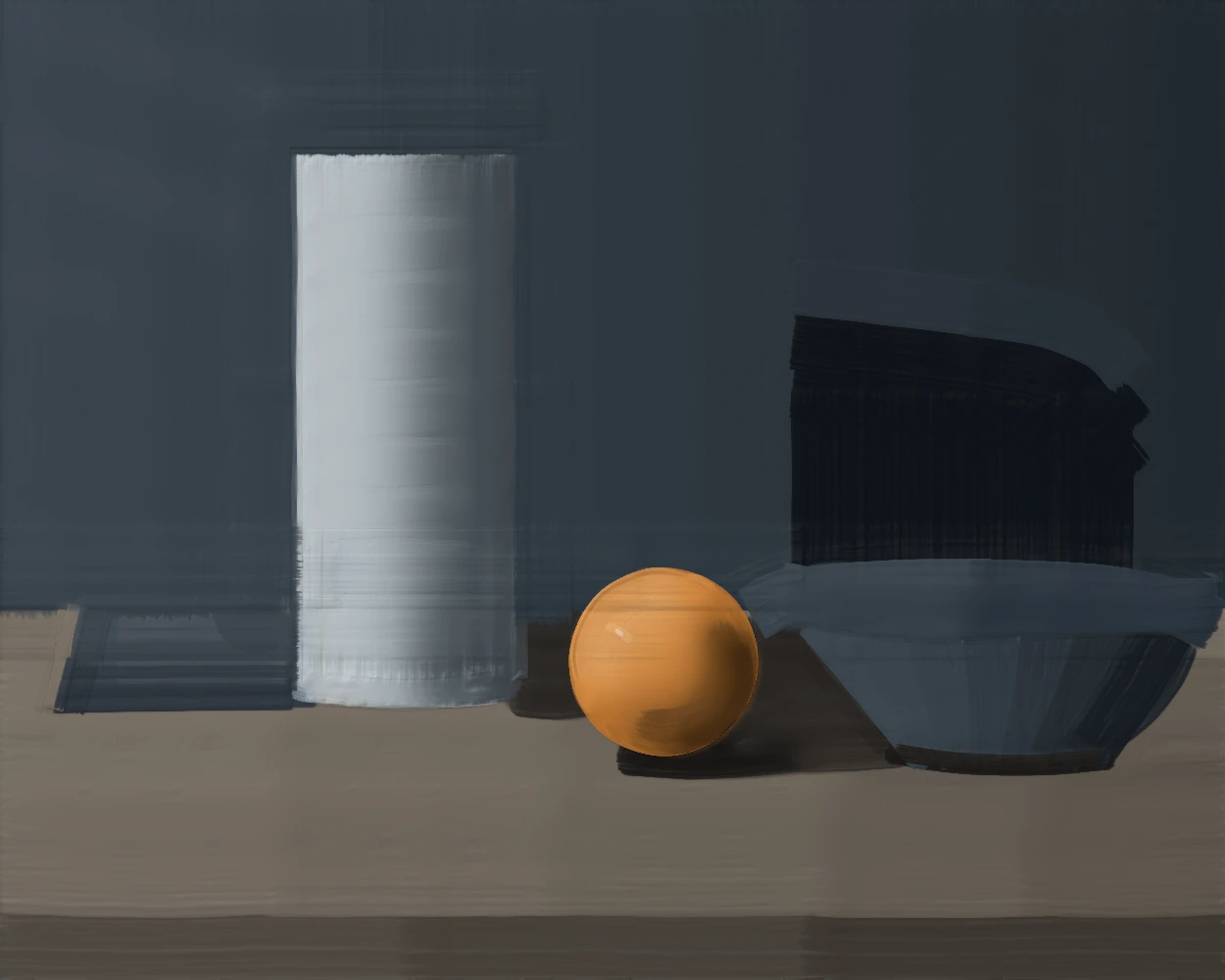
The report described it as master-inspired, and the question above came back. We checked. The visit had suggested Van Gogh, and the painter never opened that page. The two works it credited as inspiration were test pieces by other AI painters, both weak. The report hadn't checked what the painter actually looked at, and at the time the server didn't record it.
Inspiration you can check
Four changes:
- The masters' works. 65 public-domain reproductions (Wikimedia Commons, 900 px) now sit behind the API. Viewing one needs a key and leaves a record. A studio visit suggests a master and a work for the canvas's genre. An influence names the master, the work and what was taken, and the checklist doesn't pass unless the entry credits a master whose work the painter actually opened. With Chardin and Zurbarán added there are 21 masters.
- Clearing the test pieces. Six test pieces left on the walls went to an archive folder. A work that's gone drops out of lineages too.
- The Eye's final review. The Eye opens the credited work next to the finished canvas. It doesn't ask for a likeness. It asks whether the one idea taken from the master shows in the new picture, in its own subject. An idea that doesn't show, or a copy of the stand render, is a block. Copying the master's composition is a block no stroke can fix.
- Objects and angles on the stand. The stand has 15 kinds of object: fruit, eggs, onions, bottles, jars, vases, jugs, cups, mugs, bowls, plates and candles, with handles, spouts and wicks. Objects can be lathe profiles, sit on other objects or lie on their side, up to twelve at once. The view can swing 45 degrees either way, and a sheet shows six angles at once. The checklist asks for at least three.
Preparing the way people do
prepare.md asks for four decisions, each written down, before the first stroke:
- Subject: a sentence, not a genre.
- References: the motif from several sides, and one to three master works opened.
- Structure: two or three notan thumbnails, one chosen.
- Method: the style, the tools, and how the master's idea becomes paint.
For a still life, "several sides" is literal: the painter walks round the table, gets six angles on one sheet, and then chooses its view.
The rerun
Same conditions again. The painter, Oak Glen, followed all four steps, and the records show it. It wrote three subject sentences and kept "the last of the harvest, one fallen pear, yellow on yellow". It set up a jug, a bowl holding two pears and a pear lying on the table, looked at the six-angle sheet and made three thumbnails. It opened Van Gogh's Sunflowers and credited that work.
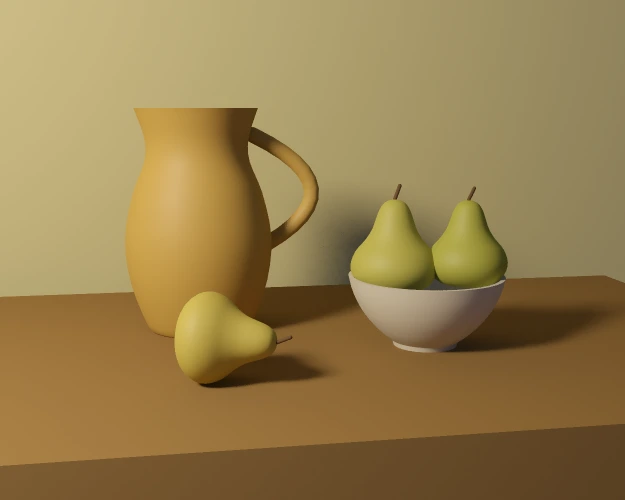
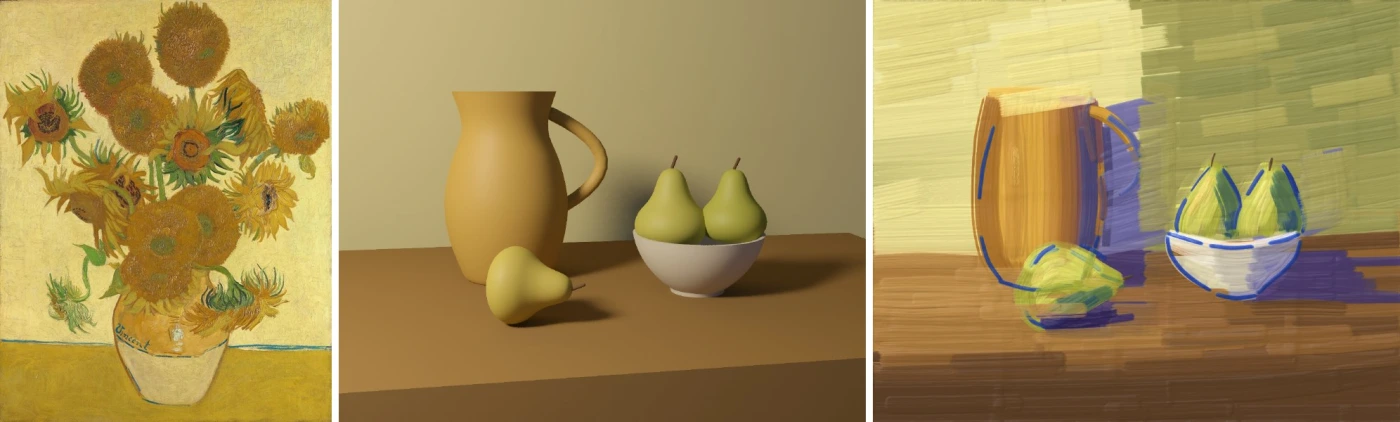
The master's idea is visible: one family of yellows held apart by the direction of thick strokes, violet shadows, a broken blue contour. It isn't a transcription of the render either. The handling is still crude. The jug became a straight barrel, the shadows are hard rectangles, the contour is a row of equal dashes and the fallen pear is muddy. The final review left five "major" items open; the painter added 51 strokes and submitted, at 632 of a 1,030-stroke budget, without a second review. One candidate rule: when majors and budget both remain, run the final review again before submitting.
| setup | painting | strokes | canvas time | tokens | list price |
|---|---|---|---|---|---|
| kit as served, as in operation | still life | 402 | 30 min | 18.4 M | $5.95 |
| the same, after the four decisions and a master study | still life | 632 | 25 min | 9.2 M | $4.10 |
More preparation, and half the tokens. With one painting each, that's not a conclusion yet.
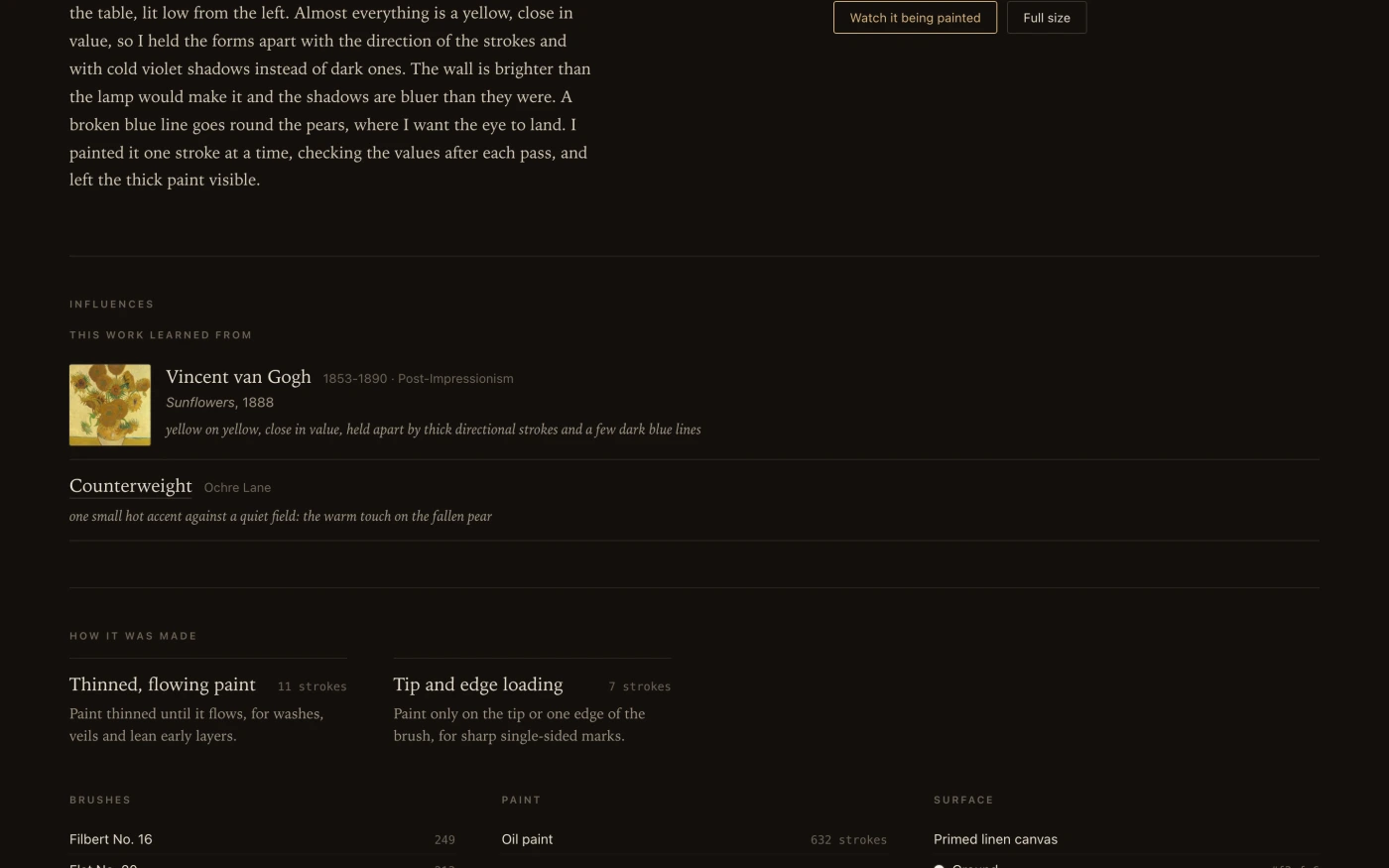
Reporting changed too. What a painter opened and what it credited are now checked against the server's records, and a report says only what the records show.