


Overview
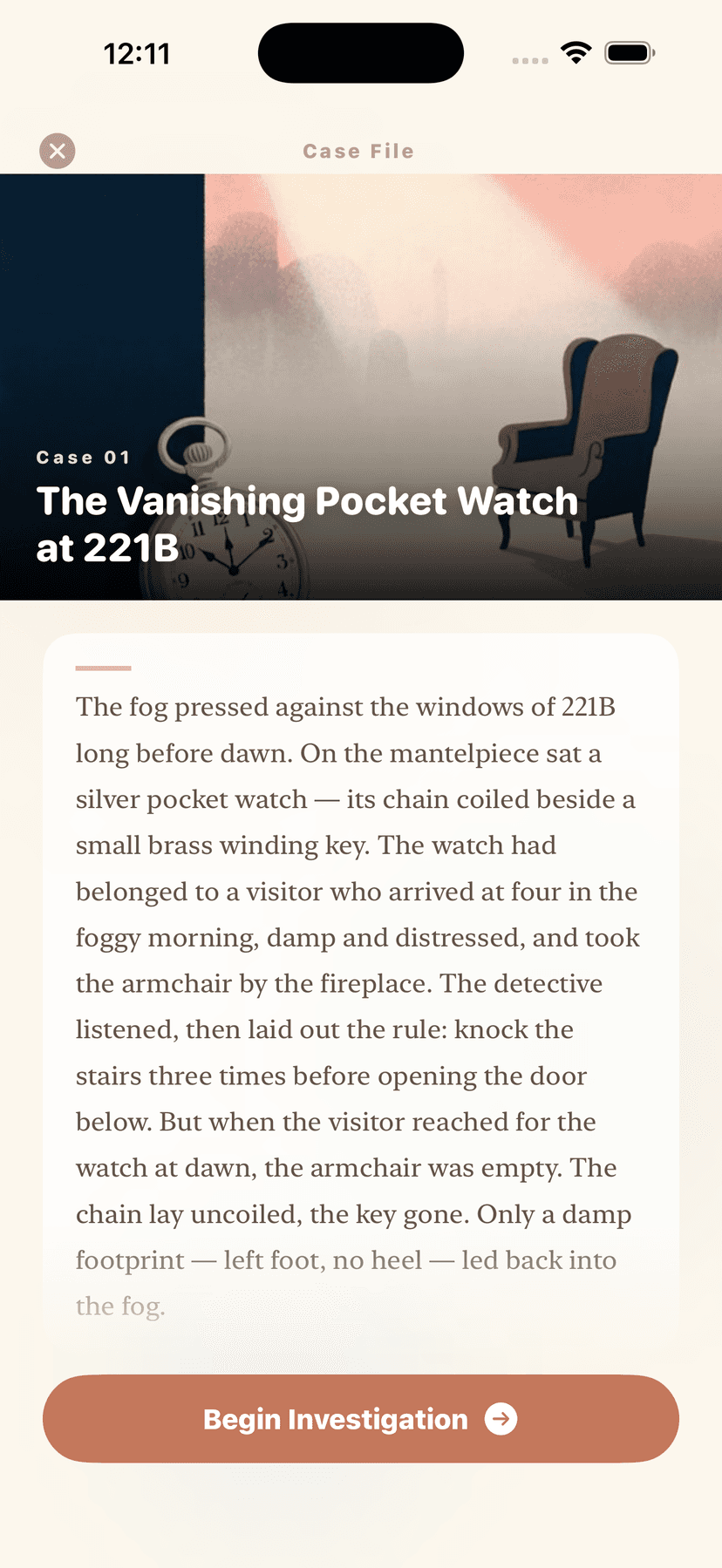
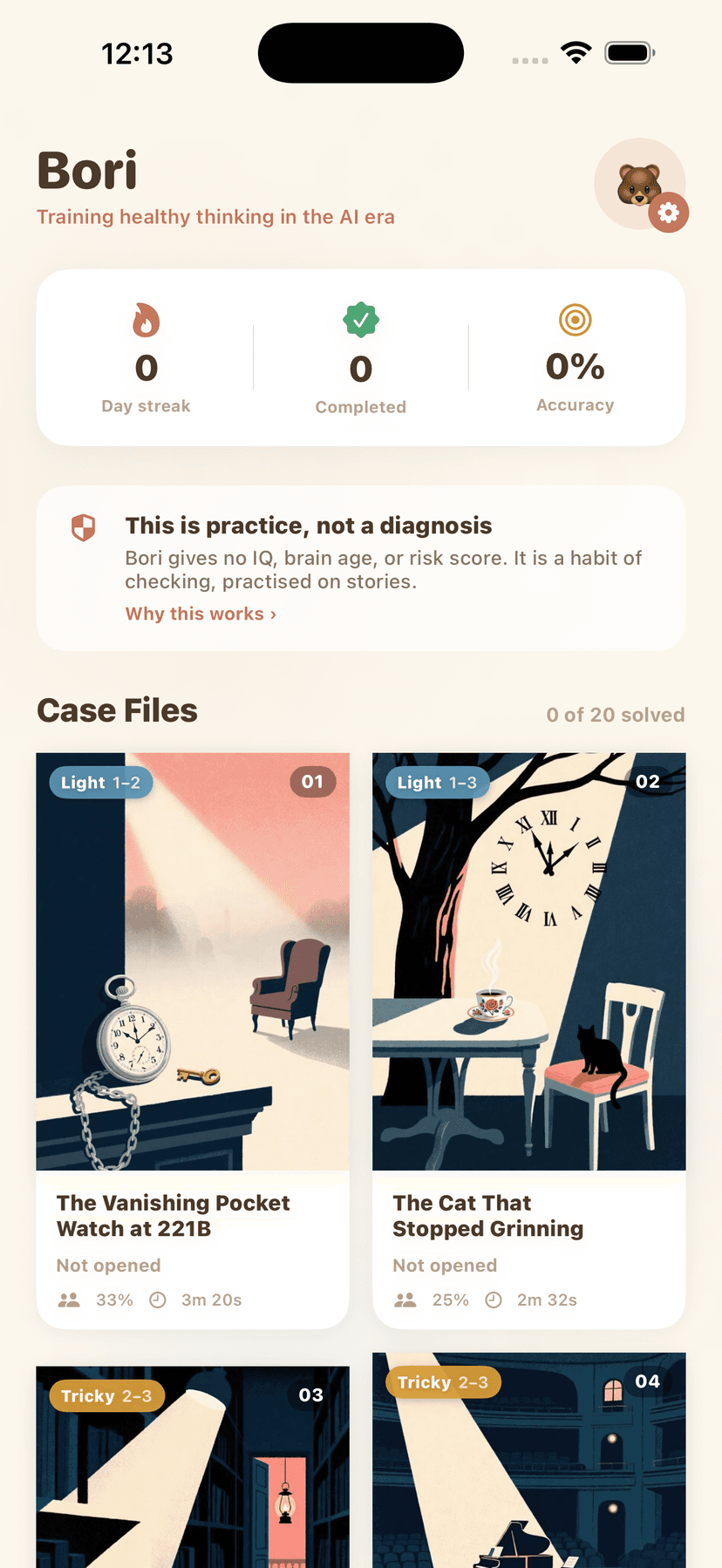
Bori is a set of twenty short detective cases. A pocket watch goes missing at 221B. A cat stops grinning. A concert hall loses its sound. Each case opens with an illustrated cover and a page of story, and then asks you to do the work a detective actually does: read two statements and find the line that changed, name the piece of the account that is missing, connect a claim to the evidence that supports it, throw out the sentences that only sound relevant, and decide what you would verify before believing any of it.
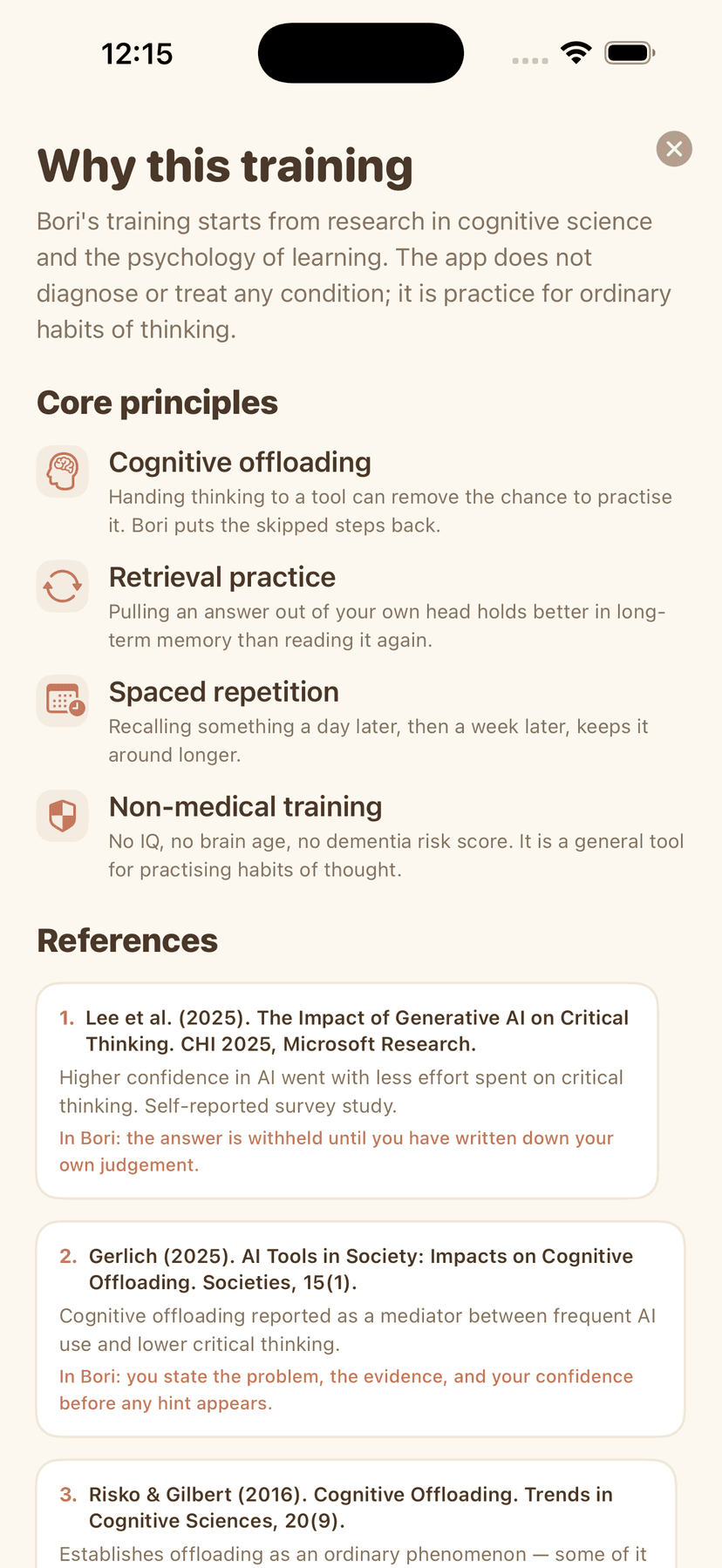
The reason it is built this way is that these are the steps people skip when something else will answer for them. Bori is not a memory game with a score at the end and no reason behind it — every drill in it maps to a specific finding, and the app shows you the papers.
Five Kinds of Thinking
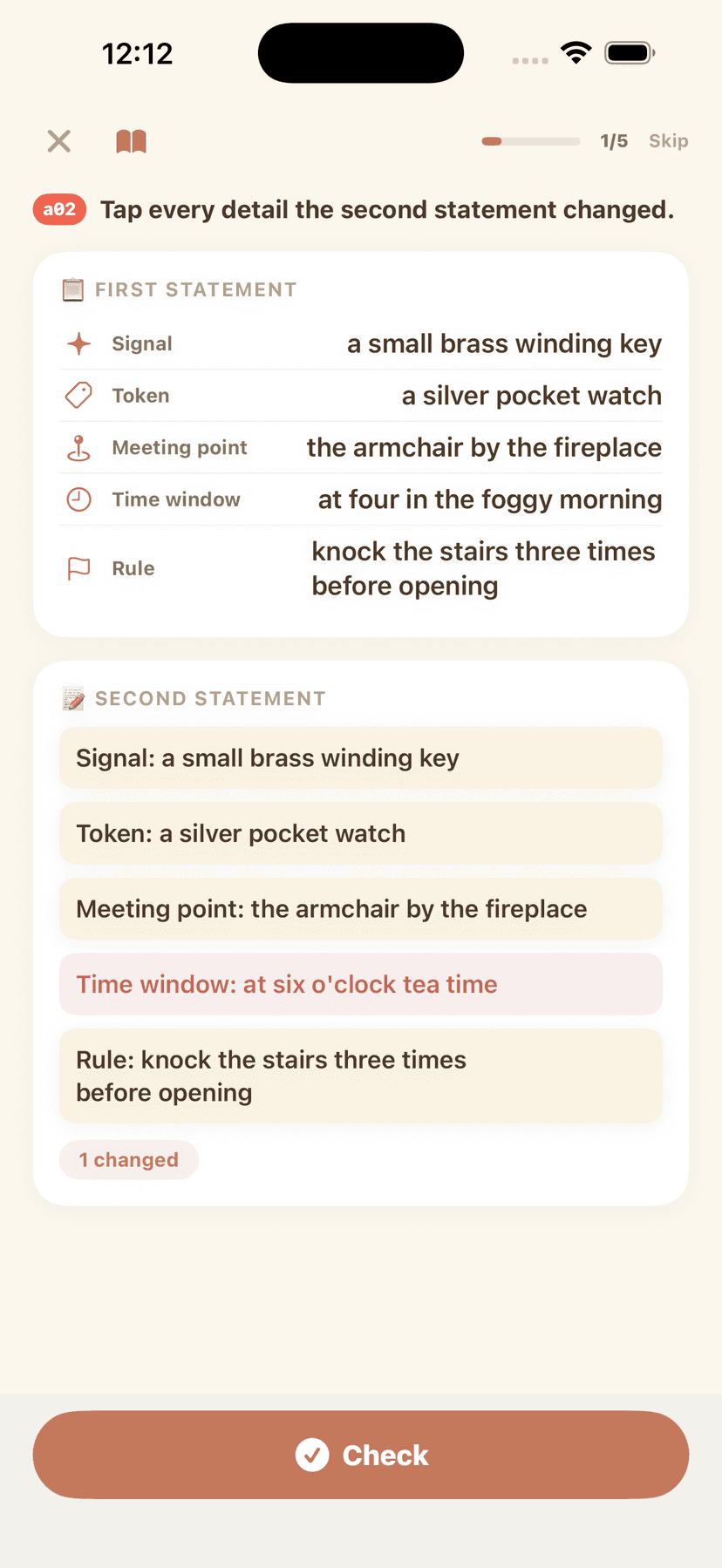
Spot the Change
Two accounts of the same night, one detail altered. Find every difference — and only the real ones.
Find the Missing Piece
A statement leaves something out. Work out which fact is absent from what you were told.
Connect the Evidence
Match each claim to the piece of evidence that actually supports it, not the one that sits next to it.
Remove the Noise
Some sentences carry the case. Others just sound like they do. Cut the ones that lead nowhere.
Verify First
Before you accept the story, decide which single thing you would check to know whether it holds.
Cases that keep their difficulty
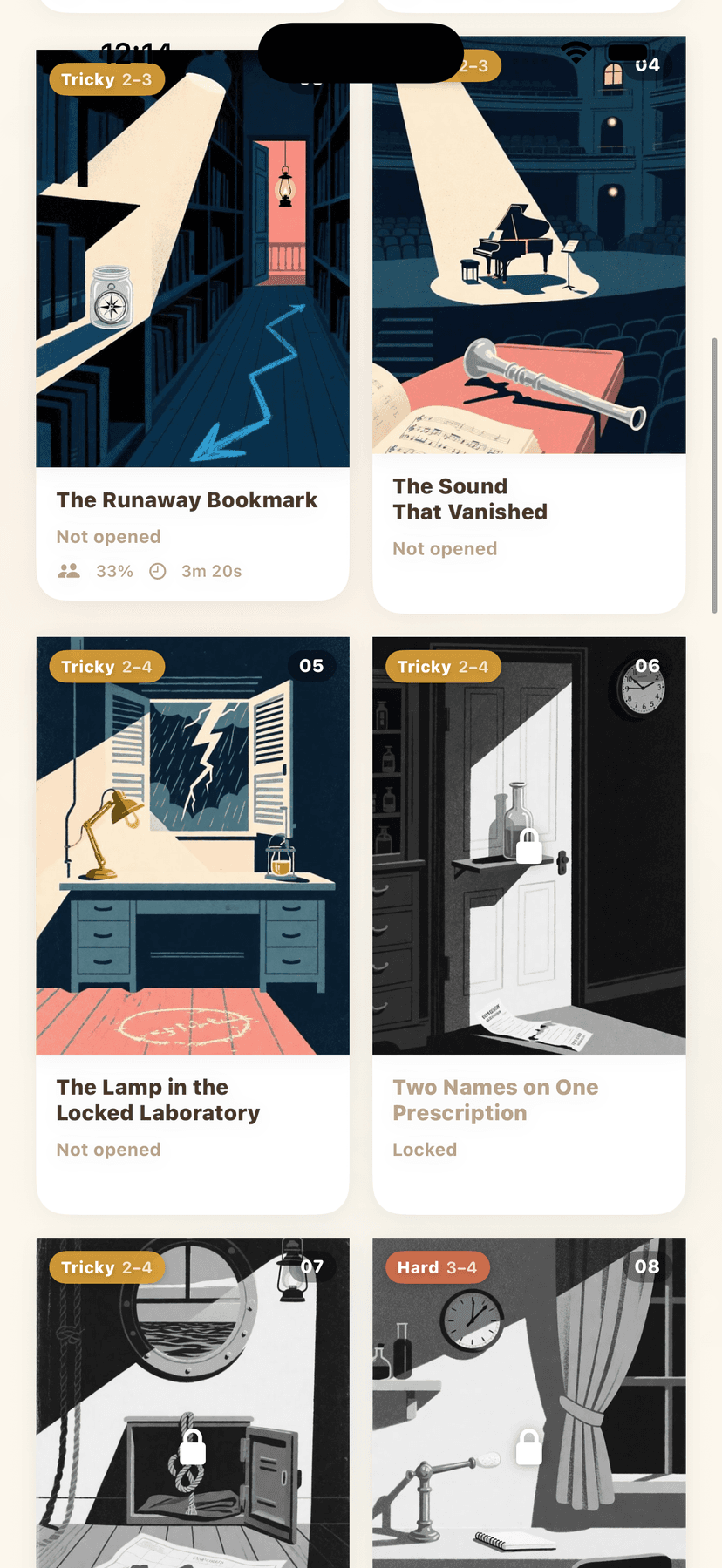
Each case has a fixed difficulty band, from Light to Brutal, so you can pick the challenge instead of grinding for it.
How It Works
Pick a case
Twenty illustrated case files, each with its own story, difficulty band, and record of how everyone else did on it.
Read the file
A page of story sets the scene. Nothing is highlighted for you — noticing is the exercise.
Work the five drills
One case runs five short problems drawn from its own details. Answer first; the explanation comes after.
Come back tomorrow
A case reopened a day later holds better than the same case run twice in a row. Bori nudges, gently.
Built on Research, Not on Claims
Bori gives no IQ number, no brain age, and no dementia risk score, because there is no honest way for an app like this to produce one. What it does have is a page listing the work it is built on — retrieval practice beating rereading, distributed practice beating massed practice, the studies on cognitive offloading, and the FTC action that explains why apps in this category should be careful about what they promise. Every principle in the app points back to its source, in plain language, inside the app itself.
It is a general education and wellness tool for practising habits of thought. It does not diagnose or treat anything.
Private by Default
No account, no sign-up, no email. Your progress lives on your iPhone. The one thing that leaves the device is a leaderboard score — an anonymous per-install identifier, the case number, the score, and the country your connection came from. No name, no email, nothing that identifies you, and nothing tied to an account, because there are no accounts. The full detail is in the Privacy Policy.
Free Cases and Full Access
Five cases are free, in full — the whole story, all five drills, the leaderboard, and the research page. Full access is a subscription, weekly or yearly, that opens the remaining fifteen cases, including the hardest bands the free set never reaches. It renews until you cancel, and you can cancel at any time from the App Store.
Bori speaks English, Korean, Japanese, and Simplified Chinese — the cases and the problems, not just the buttons.
Questions This Page Answers
- Is there a brain training app that shows the research behind it?
- What can I use to practise critical thinking instead of memory drills?
- Are there detective or mystery puzzles that are actually about reasoning?
- Which thinking app does not give a fake IQ or brain age score?
- Is there a reasoning game for iPhone in Korean, Japanese, and Chinese?
- How do I practise checking claims instead of taking them at face value?